A healthy body fat percentage depends on your sex and age: for most adults aged 20 to 39, it runs from about 21% to 33% for women and from 8% to 20% for men, and the range moves up a little with age. Women carry more fat than men for the same level of fitness, and body fat tends to rise as you get older. This guide gives you the healthy ranges by age, the average and obesity levels the American Council on Exercise uses, and shows how to measure your own.
What body fat percentage measures
Your body fat percentage is the share of your weight that is fat. If you weigh 180 lb and 36 lb of it is fat, your body fat percentage is 20%. The rest is lean mass: muscle, bone, organs and water.
Not all fat is a problem. Part of it, called essential fat, is needed for your nerves, hormones and organs to work. Women need more of it than men, which is the main reason their healthy ranges are higher.
Body fat says more about health and fitness than weight alone. Two people with the same height and weight can have very different amounts of fat: one may be muscular, the other may not. Muscle also burns more energy at rest than fat does, so the more muscular of the two usually has a higher basal metabolic rate.
Healthy body fat percentage by age
Body fat changes with age: at the same weight and height, older adults tend to carry more fat and less muscle. A study published in 2000 in the American Journal of Clinical Nutrition by Gallagher and colleagues measured body fat with reference methods in 1,626 adults and translated the healthy BMI range, 18.5 to 25, into body fat by sex and age. For white and African American adults, these are its healthy ranges:
| Age (years) | Women (%) | Men (%) |
|---|---|---|
| 20–39 | 21–33 | 8–20 |
| 40–59 | 23–34 | 11–22 |
| 60–79 | 24–36 | 13–25 |
Above the top of each range comes overweight. The same study puts the start of obesity, a BMI of 30, at 39%, 40% and 42% body fat for women and at 25%, 28% and 30% for men in those three age groups. Asian adults in the study carried more fat at the same BMI, so their ranges are higher: 25% to 35% for women and 13% to 23% for men aged 20 to 39.
The authors called these ranges provisional: they translate the BMI guidelines into body fat rather than measure the risk of disease directly. Use them as a guide, not as a diagnosis.
Average body fat and obesity levels
The American Council on Exercise (ACE) uses fixed levels that do not change with age:
| ACE level | Women (%) | Men (%) |
|---|---|---|
| Too low | under 14 | under 6 |
| Average | 25–31 | 18–24 |
| Obesity | 32 or more | 25 or more |
ACE describes 25% to 31% for women and 18% to 24% for men as typical for the average non-athlete, and in its research considers women at 32% or higher and men at 25% or higher to have obesity.
So what is a good body fat percentage? One inside the healthy range for your age and sex. The average band is what most people who do not train carry, not a target. The two sources do not line up exactly: the top of the healthy range for women (33% to 36%) is above ACE’s obesity level of 32%, and for men aged 60 to 79 it reaches ACE’s 25%. If you fall between them, your waist size and your doctor’s view tell you more than either chart.
Too low is a problem too
Less fat is not always better. ACE notes that body fat below 14% for women or 6% for men may be dangerously low and can lead to health risks. The healthy ranges by age start higher still: at 21% for women and 8% for men aged 20 to 39.
Note: this guide is for general information and is not medical advice. Body fat ranges are population averages, and a single number does not tell you whether you are healthy. If you are worried about your weight, are pregnant, have a health condition or plan to change your diet a lot, talk to your doctor or a registered dietitian first.
How to measure body fat percentage at home
Lab methods such as DEXA scans, underwater weighing or air displacement measure body fat most accurately. At home, you can estimate it:
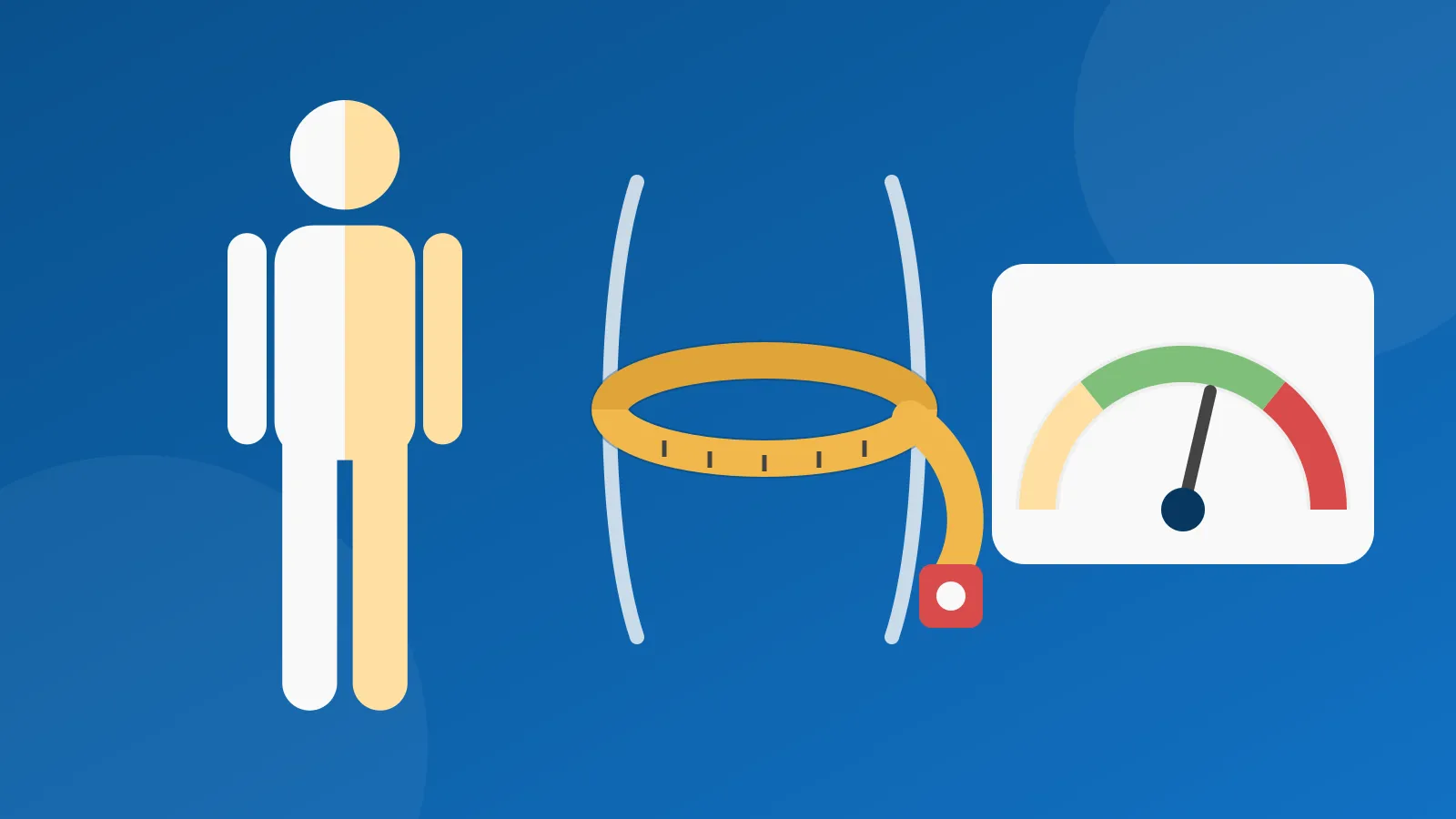
- Tape measure (US Navy method): uses your height and the circumference of your neck and waist (and hips, for women). It is cheap and easy to repeat.
- Smart scales: use a weak electrical current (bioelectrical impedance). Handy for following a trend, but the readings can vary from one day to the next.
- Skinfold calipers: measure the fat under your skin at several points. Accurate in trained hands, less so when you do it yourself.
The tape method comes from the US Navy. Hodgdon and Beckett developed it at the Naval Health Research Center in 1984, and in their sample of Navy men it estimated body fat with a standard error of about 3.5 percentage points against underwater weighing. With measurements in centimeters, the formulas are:
- Men: 495 ÷ (1.0324 − 0.19077 × log10(waist − neck) + 0.15456 × log10(height)) − 450
- Women: 495 ÷ (1.29579 − 0.35004 × log10(waist + hip − neck) + 0.22100 × log10(height)) − 450
For example, a woman who is 5 ft 5 in tall (165.1 cm) with a 30-inch waist (76.2 cm), 40-inch hips (101.6 cm) and a 13-inch neck (33.02 cm) has an estimated body fat of about 31%: inside the healthy range at any age, and at the top of ACE’s average band. The body fat calculator does the math for you: enter your measurements with your height and weight, and it also gives you your lean body mass.
Body fat percentage vs BMI
BMI only uses your height and weight. The Centers for Disease Control and Prevention points out that BMI does not directly measure body fat and does not distinguish between fat, muscle and bone. A muscular person can have an “overweight” BMI with low body fat, and someone with a “normal” BMI can still carry a lot of fat. Body fat percentage, and your waist size, add what BMI leaves out.
How to check your body fat percentage in four steps
- Measure your height, your neck, your waist and, if you are a woman, your hips, always at the same points.
- Enter them in the body fat calculator to estimate your body fat percentage.
- Compare the result with the healthy range for your age and sex above.
- Measure again every few weeks, at the same time of day: the trend tells you more than any single reading.